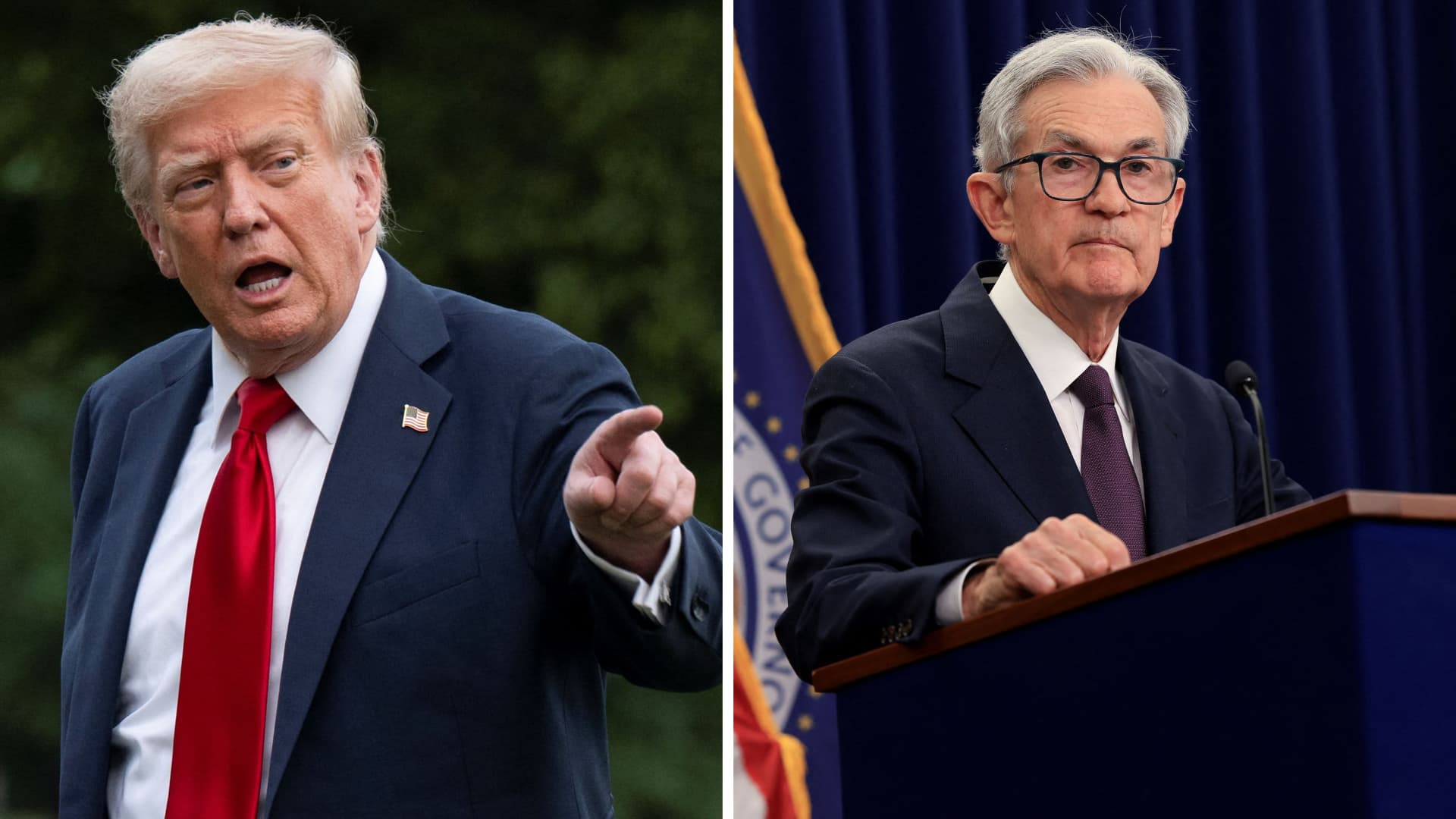

Regardless of escalating political strain from President Donald Trump, the Federal Reserve is predicted to carry rates of interest regular at its coverage assembly this week.
Amid a considerably softening labor market, inflation pressures and an unsure geopolitical panorama, futures market pricing is implying nearly no probability of a price reduce, in response to the CME Group’s FedWatch gauge.
The Fed’s pause could disappoint Individuals looking forward to decrease debt funds, in response to Matt Schulz, LendingTree’s chief credit score analyst.
“Even so, charges on a number of kinds of loans are at their lowest ranges in years and are more likely to maintain falling, no less than for a short time longer,” Schulz mentioned. “That is welcome information as affordability points proceed to plague households across the nation.”
Trump vs. Powell
Ought to the Fed pause as anticipated, Trump is more likely to be essentially the most vocal critic of the central financial institution’s resolution.
The president ratcheted up his criticism of Fed Chair Jerome Powell on the World Financial Discussion board in Davos, Switzerland, final week and mentioned in a CNBC interview that he had narrowed down the checklist of candidates to succeed Powell “all the way down to possibly one.” He is extensively anticipated to choose somebody who’s inclined to chop charges extra aggressively.
The president mentioned in remarks final week that inflation has been “defeated.” He has additionally mentioned in prior feedback in regards to the Fed that sustaining a federal funds price that’s too excessive makes it tougher for companies and shoppers to borrow, placing the U.S. at an financial drawback to nations with decrease charges.
President Donald Trump gestures as he delivers a particular handle through the World Financial Discussion board annual assembly in Davos, Switzerland, Jan. 21, 2026.
Mandel Ngan | Afp | Getty Pictures
The Fed’s benchmark units what banks cost one another for in a single day lending, but in addition has a trickle-down impact on lots of the borrowing and financial savings charges Individuals see day-after-day.
Shorter-term charges are extra intently pegged to the prime price, which is often 3 proportion factors above the federal funds price. Longer-term charges are extra depending on inflation expectations and different financial elements.
Altogether, the influence of the Fed’s actions varies considerably throughout several types of loans.
Mortgages
Fastened mortgage charges, for instance, do not straight monitor the Fed however usually observe the lead of long-term Treasury charges.
The typical price for a 30-year, fixed-rate mortgage was 6.19% as of Friday, in response to Mortgage Information Day by day, down from over 7% a 12 months in the past — helped partially by Trump’s push to have Fannie Mae and Freddie Mac purchase $200 billion in mortgage bonds.
Simply on Trump’s announcement of that plan, the common price on the 30-year fixed-rate mortgage sank briefly under 6% earlier this month.
“Mortgage charges did dip under 6% in current weeks for the primary time in years, solely to spike once more this previous week attributable to geopolitical chaos surrounding Greenland,” mentioned Melissa Cohn, regional vp of William Raveis Mortgage. If tensions simmered, charges might ease once more, she mentioned, however “charges go up method quicker than they arrive down.”
Bank cards
In contrast, most bank cards have a variable price, so there is a extra direct connection to the Fed’s benchmark.
Following three consecutive price cuts in 2025, the common bank card rate of interest within the U.S. fell to 23.79% in January, marking the bottom stage since March 2023, in response to LendingTree.
Nonetheless, “these charges usually are not going to return all the way down to a stage that’s going to ease the burden on those that are carrying a steadiness,” mentioned licensed monetary planner Stephen Kates, a monetary analyst at Bankrate.
Presently, about 175 million folks within the U.S. have bank cards, and whereas some repay the steadiness every month, roughly 60% of bank card customers have revolving debt, in response to the Federal Reserve Financial institution of New York.
Nevertheless, Trump is making an attempt to have a hand in right here, too. Trump’s name for a momentary 10% cap on bank cards, might imply considerably decrease rate of interest expenses for individuals who carry a steadiness from month to month. But executives at a few of the greatest U.S. banks, together with JPMorgan Chase CEO Jamie Dimon, have mentioned this kind of coverage “can be an financial catastrophe.”
Auto loans
Trump lately mentioned that automotive funds, amongst different bills, are “coming down.”
Though rates of interest on new-car loans have edged decrease, automotive consumers are financing bigger quantities, so the affordability crunch has solely worsened.
The typical quantity financed for a brand new automotive reached an all-time excessive of $43,759 on the finish of final 12 months, in response to Edmunds. The typical month-to-month cost on a new-vehicle buy is at a recent excessive, as is the share of new-car consumers with an auto cost of $1,000 or extra.
“The borrowing panorama stays fairly unfriendly for automotive consumers, who’re nonetheless coping with sky-high costs and rates of interest that haven’t meaningfully budged regardless of the three price cuts final 12 months,” mentioned Joseph Yoon, shopper insights analyst at Edmunds.